
Down Lights (or recessed lighting)
Please note that all electrical wiring and installation details given on diydata.com is for information purposes only.
From 1st January 2005, the Building Regulations Part P requires, in England and Wales, that only certified persons can carryout electrical installation work, or the work must be certified upon completion - see this page for more details.
Always isolate any electrical circuit before working on the circuit.
 Down
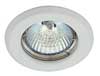
lights, mounted in the ceiling, are becoming increasingly popular for lighting living areas, kitchens and bathrooms. A great advantage of down-lights is that they give even, gentle, low shadow lighting within a room.
Down
lights, mounted in the ceiling, are becoming increasingly popular for lighting living areas, kitchens and bathrooms. A great advantage of down-lights is that they give even, gentle, low shadow lighting within a room.
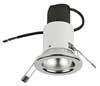 The main part of the bulb is contained within a housing above the ceiling, the housing (or "can") is normally sealed to avoid the bulb acting as a chimney; if the can is not sealed, when the bulb gets warm, air is drawn up into the void above the ceiling.
Most modern cans are secured to the ceiling by simple clips which are engage when the fitting is pushed up into the ceiling from below. To remove the can, simply grip the inside of the can (having first removed the bulb) and pull down - the clips should work in reverse allowing the can to be pulled down clear of the ceiling to the extent of the cable.
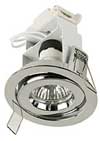
As well as ordinary downlights with round bezels, other options are available:
|
Downlight with adjustable bulb |
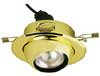 |
Eyeball type spot downlight - mainly used to illuminate specific areas or items in the room |
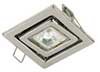 |
Square, adjustable downlight |
Mains or low voltage
Downlights can be mains powered or low voltage (typically 12 volts) - 'low voltage' does not mean 'high efficiency', typically the transformer will waste energy, so overall a low voltage installation will use more electricity than a conventional mains installation - although low voltage bulbs do tend to last longer.
Transformers for low voltage downlights come in different electrical sizes (sometimes referred to as 'so many va' - simply the total of volts multiplied by amps - and this is the same as watts) so a 100 va transformer can handle 5 x 20 watt low voltage bulbs - it's best to match the transformer to the number of bulbs being used although a number of transformers can normally be connected to the same light switch so it shouldn't be apparent if more than one transformer is being used.
Most transformers for low voltage downlight incorporate a thermal cut-out so that if the transformer should overheat, it will cut off the supply before it caused damage. Transformers should only overheat if:
- They are used to drive more bulbs (or higher wattage bulbs) than they are designed for.
OR - They do not surrounded by free air to allow heat to dissipate (could be they are covered by loft insulation).
Bulbs for downlights
Most recessed down lights use halogen bulbs, these give fairly good bulb life. LED lights are just becoming popular giving coloured lighting (great for children's rooms) but they do not really give enough light for ambient lighting. Typically mains bulbs used are 50 watt while low voltage systems use 20 watt - each giving similar levels of illumination.
Halogen bulb, mains downlights can be dimmed using normal light dimmers, low voltage need a special kit to dim.
Spotlights are different from ordinary downlights, often using 60 watt spotlight bulbs.
Downlights in Bathrooms
Be careful when choosing downlights for bathrooms, they need to conform to the electrical regulations which depends upon their actual position - see bathroom electrical zoning page.
Positioning downlights.
For general, ambient lighting, downlights should be positioned about 6 or 7 ft (1.8 to 2.1 m) apart in both directions (i.e. across the room as well as along the room). Before deciding on the spacing, check the position of the joists above the ceiling - you want to use a spacing which will position the downlights between joists. Keeping adjacent downlights between the same pair of joists will make running the cables easier.
Don't be tempted to position downlights close to walls; the down light will show up every imperfection - try to keep them 3 to 3 ft 6 in (0.9 to 1.05 m) from the ceiling/wall corner.
Don't overload your existing electrical wiring - most mains house lighting circuits can handle 400 watts per room, this allows for up to 8 downlights per room per circuit. If in doubt, consult a qualified electrician.


 Top
Top