
Rain water Guttering
guttering tips - accessories for rainwater guttering - accessories for downpipes
Types of guttering
The type of guttering on an existing building will generally reflect the period in which it was built - cast iron, rolled steel, cement or plastic. Plastic is generally the material now used on new buildings, although seamless aluminium guttering is becoming quite widely used.
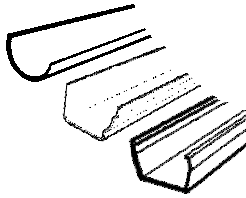 Cast iron guttering is commonly available in three shapes: half-round, square and ogee (OG). Half-round and square types rest in brackets fixed to the fascia board, rafters or brickwork. Ogee section was often screwed directly to the fascia using large head screws through the back of the guttering, alternatively it was supported on brackets. Generally metal guttering was not fixed to the brackets, the weight of it being sufficient to hold it in place. Where Ogee is screwed to the fascia, it is often found that the screw heads rust away making them impossible to unscrew and, sometimes, making the whole guttering dangerous as there is little screw head material holding it in place.
One end of each length of cast iron guttering has an outer joint profile lip, while the other end has the appropriate standard guttering profile. The second end could be cut to length and then sits into the outer lip of the adjacent length. Originally the joints were sealed using red lead, putty or other jointing material and secured with bolts through the bottom. With age, these sealants become brittle, and leak; the bolts become rusted and impossible to remove other than with a hacksaw or angle grinder. Cast iron needs to be painted to protect it from the environment. Cast iron downpipes generally have a larger diameter for the upper end into which the standard diameter lower end fits. Normally the joints were sealed by putty or similar; down pipe joints should not leak because the upper pipe normally fits into the lower pipe.
Rolled steel and cement guttering are very similar to cast iron with regard to fixings and joints (although they are always supported using brackets, not by screws through the actual guttering). The problems with sealant and joint securing bolts are the same. Rolled steel needs to be painted (like cast iron), however cement guttering tends to be left unpainted to weather. Down pipes often do not have any sealant at joints, the upper pipe just sits inside the lower pipe.
Modern plastic rainwater systems are lightweight, durable and are generally self-coloured (generally limited to white, black, brown or grey). Plastic guttering is available in half-round, ogee, square section and a number of other profiles sometimes unique to a particular manufacturer. Each manufacturer tend to have their own arrangements for fixing and joining; some use brackets and separate joining clips, whilst others use brackets incorporating the joining clips. Generally the joining clips incorporate some form of rubber seals and, to ensure a good seal, the clips often require considerable pressure to fix them in place. The rubber seals are generally very effective, often problems only arise after a joint has been broken and remade without proper cleaning of the gasket or the under surface of the guttering. Round plastic down pipes may use an 'o'ring to seal one length to another, or the upper pipe may just sit inside the lower - some manufacturers use a plastic cement to permanently join the pipes. Square down pipes usually use a fairly tight push fit, a loose fit or plastic cement to join the lengths.
- The area of the roof and the level of rainfall determines the size of profile required. The 3 inch round profile is generally only suitable for small sheds.
- The manufacturer will specify the maximum distance between adjacent support brackets and between a bracket and an unsupported end or downpipe connection. As a rough guide, brackets should be no more than 1 metre apart - corners, end stops, downpipe connects should be supported by a bracket no more than 150mm on each side.
- The run of guttering should be no less than 25mm over 3 metres (1 in over 10 ft) with the lowest point being the downpipe connection. Where a building has more than 1 downpipe, try to set the slope of the gutter to even out the area of roof feeding each downpipe.
In addition to the actual lengths of guttering, various fixings are available:
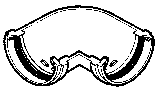 Corners - 90 degree and other angles to continue the guttering run around corners.
  End closures - to close the ends of guttering where one length is not joined to another.
 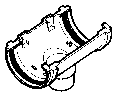 Down pipe connector - a short length of guttering with a downpipe connector fitted to the bottom.
  Eve support bracket.
 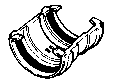 Joining piece - this shows a free joining piece which can be used in between brackets. Some ranges of guttering have the joint gasket and clip incorporated in the support brackets while other ranges have the joints incorporated in one end of the guttering length.
Most ranges include downpipes and accessories; whether the basic pipe is round or square, the following accessories are normally available to suit:
 Pipe connector - this may be incorporated into one end of the actual pipe. It enables an upper pipe to fit inside a lower pipe so that there is no need for a watertight seal where the pipes join.
 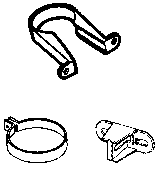 Brackets to hold the pipe. Two sorts are generally available, the saddle bracket (upper) and the two piece, barrel clip (lower). The saddle just holds the pipe away from the wall while the barrel clip gives a firmer grip to the pipe and prevents it moving up and down.
 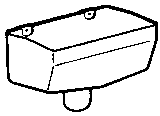 Hopper - these allow more than one downpipe to be combined. In older buildings, hoppers can be found that take 'grey water' (e.g. from a bath or basin), modern building regulations do not allow this in the UK.
 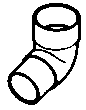 Bend - bends tend to be either 95 degree or 114 degree, (often quoted as 85 or 66 - these being the reverse angles). These angles ensure that no downpipe runs horizontal, thus avoiding the possibility of stagnant and reducing debris build up.
 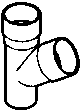 Single branch for joining two down pipes together.
 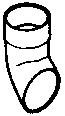 Shoe or outlet to direct the waste water at the bottom of a pipe.
guttering tips - accessories for rain water guttering - accessories for downpipes


 Top
Top