
Smoke detectors and alarms
Properly installed smoke detectors/alarm will detect smoke from a fire and set off an alarm that will then warn of a fire and possible save lives. There are two types of smoke alarm:
Ionisation Alarms. These detect all types of smoke that contain small particles, but they respond most rapidly to smoke caused by fires such as a chip pan fire.
The detector in these alarms consists a small amount of radioactive material that detects any invisible smoke particles that are floating in the air. When particles in the smoke are detected, the alarm is set off.
Optical Alarms. These detect all types of smoke, but are ideal for smoke with larger particles, such as burning furniture. In this alarm regular pulses of Ultra Violet light are sent to a detector, if the light is prevented from reaching the detector, the alarm will sound.
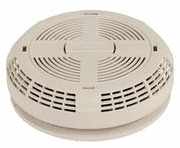 The
two types can have identical external appearances, so check the packing it is supplied with or the label inside. As a rule of thumb use ionisation alarms for areas like halls and bedrooms and optical alarms in the kitchen or sitting room.
The
two types can have identical external appearances, so check the packing it is supplied with or the label inside. As a rule of thumb use ionisation alarms for areas like halls and bedrooms and optical alarms in the kitchen or sitting room.
Before installing a smoke alarm always read the manufacturer's Instructions carefully.
Building Regulations require that at least one smoke alarm, wired directly to the mains, is installed in every new property. The regulations go on to say that smoke alarms should comply with BS5446. Even in existing buildings, all smoke detectors should be to British Standard BS5008 or BS5446 or BS kite marked. Other situations, such as properties of multiple occupation, B&Bs etc, require smoke detectors to building regulations - if in doubt, check with the local Building Control Office.
If installing mains operated smoke alarms then the installation must comply with the current IEE wiring regulations. It is worth incorporation a back-up battery in case there is a mains failure.
Smoke detectors/alarms are offered with a mixture of various features:
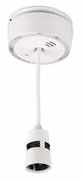 Some mains powered detectors are housed in the ceiling rose of ordinary lights (as shown right). This makes them rather unobtrusive.
 - Most have some form of alarm that indicates when the battery needs replacing.
- Some have alarms that indicate when the sensor needs cleaning.
- Some alarms (specifically designed for kitchens) have a silencer that stops the alarm operating for about eight minutes while cooking. During this time they emit an intermittent bleep to indicate that the alarm has been silenced.
- Some alarms can be interconnected so that all of them will sound when any one alarm senses smoke.
- The alarm may have an emergency light which illuminates when the alarm goes off. The emergency light will help people escape.
It is pointless having smoke alarms if the occupants of the building have no idea what to do when they operate. Escape routes should be established for every room and everyone in the building should be made aware of these routes. Escape routes must be unobstructed at any time, if window locks are fitted, make sure that a key is always located by each window.
REMEMBER:
- Always follow the manufacturer's installation and maintenance requirements carefully.
- Remember to check the operation of each detector once a month and replace the batteries every year (or as directed by the manufacturers).
- Only the use the type of battery specified by the manufacturer.


 Top
Top